This post is based primarily on Don's notes, occasionally supplemented with MT's notes from our tour of Sicily in September 2023. When information from other sources is added—for further explanation to readers or to satisfy our own curiosity—that is set off in a text box (as this one).
Most of the photos that accompany this post are from Don’s camera (with a caption indicating the time it was taken); those from MT’s iPhone are indicated by “MT” placed at the beginning of the photo caption. Photos from any other source (such as the public domain Wikimedia Commons), occasionally used for clarification, indicate that source in the caption.
Most of the photos that accompany this post are from Don’s camera (with a caption indicating the time it was taken); those from MT’s iPhone are indicated by “MT” placed at the beginning of the photo caption. Photos from any other source (such as the public domain Wikimedia Commons), occasionally used for clarification, indicate that source in the caption.
We woke at 6:40 am and ate breakfast at Artemis Hotel, at Via Roma 101, around 8:30.
Then we set off to explore Cefalù.
Cefalù (Sicilian:
Cifalù), classically
known as Cephaloedium (Ancient Greek: Κεφαλοίδιον, Romanized Cephaloidion),
is a city and commune in the Metropolitan City of Palermo. It is located on the
Tyrrhenian coast about 70 km (43 mi) east of the provincial capital. The town
(pop. 13,777) is one of the major tourist attractions in the region.
First, we walked up Via Roma and Corso Ruggero toward the Cathedral.


MT Thursday, September 21, 2023, 8:03 AM - Cefalù: laundry hanging on balcony (mild telephoto 38 mm).

MT 9:50 AM - Cefalù: "Pesce Fresco "(Fresh Fish) in store along Via Roma.

9:53 AM - Cefalù: view from Via Roma (street sign on building at left for "Largo di Giorgio" cross street) toward Castello on La Rocca behind building on right.

MT 9:54 AM - Cefalù: Castello on La Rocca (telephoto 133 mm).

MT 9:56 AM - Cefalù: Lara and Chiara at fruit and vegetable store.

MT 9:58 AM - Cefalù: sidewalk dining of Porta Terra Ristorante on Piazza Garibaldi (where Via Roma meets Corso Ruggero); at left is portal of Chiesa di Santa Maria della Catena (Church of Saint Mary of the Chain), with address also on Piazza Garibaldi (although one of the signs to the right of that portal said "Corso Ruggero") (mild telephoto 46 mm).
We would come back to this square around noon.

MT 10:03 AM - Cefalù: Don (with day pack) on Corso Ruggero.

MT 10:03 AM - Cefalù: Don (with day pack) farther down Corso Ruggero toward Cathedral.

MT 10:08 AM - Cefalù: narrow street with car trying to pass woman with baby and carriage.

MT 10:08 AM - Cefalù: policemen that MT asked for directions.
.jpg)
Cefalù: Cathedral west façade (By User:Matthias Süßen - Own work, CC BY-SA 4.0,
https://commons.wikimedia.org/w/index.php?curid=62829098).
The Cathedral of Cefalù (Doumo di Cefalù) was erected in 1131-1240 in a style of Norman architecture that would be more accurately called Sicilian Romanesque. The well-preserved exterior is largely decorated with interlacing pointed arches, and the windows are also pointed (each surmounted by a small spire added in the 15th century). On each side of the western façade is a massive Norman tower of four stories. The façade was completed in 1240 and the cathedral was consecrated in 1267. The 15th-century portico between the two towers has three arches, the two outer ones being pointed. The round-headed Normal portal, called the Porta Regum (King’s Door), added under the portico in 1472, is worthy of note. The semicircular apse set into the east end wall has a formidable image of Christ Pantokrator, reminiscent of the Byzantine era. The building has a fortress-like character and dominates the skyline of the medieval town. The interior is on a Latin cross plan, divided into a nave and three aisles by arcades of antique columns. The 16 interior columns with Roman capitals probably came from the Temple of Diana on La Rocca. The bases and capitals are from the 2nd century AD. Two large capitals supporting the triumphal arch of the nave were probably made by a Sicilian workshop in the mid-12th century.
Mosaics. It was probably
planned that the entire church be decorated in mosaic, but this was completed
only in the presbyterium area (interior of the apse and side walls). Mosaic
still covers the apse and about half of the side walls. Roger II brought
masters in the technique of mosaic from Constantinople. They adapted their
traditional Byzantine decorative art to an architectural style that was of
northern European origin.
.jpg)
Cefalù: Cathedral – mosaic of Christ Pantokrator (By Gun Powder Ma - Own work, (CC
BY-SA 3.0, https://commons.wikimedia.org/w/index.php?curid=4463399).
The dominant figure is a bust of Christ Pantokrator (Christ in His Majesty), portrayed on the semidome of the apse with his right hand raise in benediction. In his left hand, he carries the Gospel of John, in which can be read, in Greek and Latin: “I am the light of the world, who follows me will not wander in the darkness but will have the light of life” (John 8:12).
.jpg)
Cefalù: Cathedral – mosaic of Virgin Mary (By Mentnafunangann - Own work, CC
BY-SA 4.0, https://commons.wikimedia.org/w/index.php?curid=138223328).
The mosaic in the upper tier of the apse wall depicts the Virgin Mary, with her hands raised in obsecration (prayer), flanked by four archangels.
The chief figures, those of Christ Pantokrator and the Virgin Mary, are clothes in blue, given luminosity by a background of gold tiles. The work is of the highest order, displaying elegance in the draping of the figures’ robes and the sensitivity of their faces and gestures. It is considered the finest Byzantine mosaic in Italy.
.jpg)
Cefalù: Cathedral – central apse with mosaics of Pantokrator and Virgin Mary above
main altar (By Holger Uwe Schmitt - Own work, CC BY-SA 4.0, https://commons.wikimedia.org/w/index.php?curid=127904907).

MT 10:19 AM - Cefalù: Cathedral, at other end of Piazza Duomo (Cathedral Square).

MT 10:20 AM - Cefalù: Cathedral of Cefalù - Don at bottom of steps leading to façade and towers.

10:20 AM - Cefalù: sign, in Italian, English, and French, for "Cattedrale di Cefalù" (Cathedral of Cefalù); English text reads:
" The Cefalù Cathedral (1131) was the bastion of the ecclesiastical politics of Roger II in Sicily. The façade is framed by two mighty towers, lightened by elegant double-lancet windows and single-lancet windows. In the mosaic decoration that covers the walls of the presbytery, the great central apse - where the imposing figure of the Pantocrator Christ (1148) stands out, is excellently preserved. Annexed to the Cathedral there is the elegant chapter cloister with coupled columns overlapped by decorated capitals. It represents one of the most remarkable examples of Romanesque sculpture in Sicily. The monumental complex is a component part of the UNESCO serial property 'Atrab-norman Palermo and the Cathedral Churches of Cefalù and Monreale': a series of nine religious and civic buildings dating back to the era of the Norman kingdom of Sicily (1130-1194). Collectively, they are an outstanding example of a socio-cultural syncretism between Western, Byzantine and Islamic cultures. This interchange gave rise to an architectural and artistic expression based on new concepts of space, structure, and decoration that spread widely throughout the Mediterranean region."

10:20 AM - Cefalù: sign, in Italian and English, for "Il Duomo di Cefalù - XII sec " (The Cathedral of Cefalù - 12th century); English text reads:
"The Cathedral of Cefalù was erected at the will of the Norman King Roger II in 1131, after a vow he made for having survived a shipwreck[:] ' If I will save myself from the waves (,,,) I will order the construction of a temple to honour you, the Holy Savior, and the Apostles, and with the Pope's permission, I will settle the Episcopal Cathedral.' The initial project was modified over the course of its construction, and as a consequence the final result differs considerably from King Roger's original idea. The Cathedral's plan is based on the Latin cross and it is divided into three apses, with three naves, which is a typical feature for the Nordic-Norman style of French and English legacy. The mosaic decorations inside the Cathedral date back to three different chronological groups. They were assigned to Byzantine architects and workers, whose Eastern style were highly influenced by the Nordic and Norman architectural styles. The final result is however sophisticated and it allows us to admire one of the typical representations of the Byzantine mosaic art: the Christ Pantocrator. Christ, master and judge, proclaims himself as the light of the universe from the pages of the Gospel he carries, in which one can read the Greek and Latin: 'I am the light of the world; those who follow me will not wander in the darkness but will have the light of life'.
"(Would you like to know more? frame the QR Code)."

10:21 AM - Cefalù: Cathedral of Cefalù - façade and towers.
At the Cathedral, we paid €9 each (reduced from €12 for age 65+) for the Cathedral tower, cloister, and Osterio Magno.

10:35 AM - Cefalù: Cathedral of Cefalù - interior from rear to Pantokrator placeholder in apse.
The ticket lady apologized for that the Pantokrator mosaic was being repaired/reconstructed.

10:36 AM - Cefalù: Cathedral of Cefalù - photo, in apse, of face of Pantokrator mosaic with caption in Italian, which translates:
"II. Face of Christ Pantocrator
"Donated to the Cathedral Basilica of Cefalù
"Made by the Regional Braille Printing House of the Italian Union of the Blind and Visually Impaired
"November 23, 2013."

MT 10:38 AM - Cathedral of Cefalù: poster of Pantokrator mosaic standing in place of the one being repaired (telephoto 72 mm).

MT 10:39 AM - Cathedral of Cefalù: view central nave from apse to rear with stained glass window; Chiara and Lara in pews at right.

10:39 AM - Cathedral of Cefalù: central apse with (temporary?) main altar and photo of poster of Pantokrator mosaic standing in place of the one being repaired; all the mosaics in this apse covered by cloth over scaffolding.

10:42 AM - Cathedral of Cefalù: apse at head of left nave, as we would later go toward cloister entrance.

10:39 AM - Cathedral of Cefalù: closer view of tabernacle in apse at head of left nave (mild telephoto 58 mm).
Then we climbed up to the towers and the passage across the roof.

10:51 AM - Cathedral of Cefalù: bell-ringing ropes and mosaic, on marble slab, at base of tower.

10:52 AM - Cathedral of Cefalù: bell-ringing ropes and mosaic, on marble slab, at base of tower.

10:52 AM - Cathedral of Cefalù: Latin engraving on same level.

10:52 AM - Cathedral of Cefalù: sign for "Lastra Musiva ed Epigrafe" (Panel with mosaic decoration and Epigraph"; just below that title is the entire Latin text of the inscription, then Italian and English text; the English reads:
"Panel with mosaic decoration
White marble with big crystals texture and with evident gray-blue veins.
"Height 0.84m, width 1.37 m,
Thickness 0.055m.
"Front part, mosaic decoration with four hearted pine cone in the corner, with the tip pointing to the central tondo.
Not carved recto.
Already used as sedes regia.
Italian
“tondo” translates as “round.” Italian has "sul recto," meaning on the right. The “sedes regia” translates from Italian as “headquarters” but from Latin as "royal seat."
"Epigraph 'of the codicils'
White marble with big crystals texture and with evident gray-blue veins.
"Height 1.25m; width 0.815m' thickness 0.045m
"Front part, mosaic decoration as in the adjacent panel.
"Already used as sedes episcopalis
"The epigraph documents the clouses of a young sicilian boy death in Pannonia.
"In the will, drawn up in Sirmio on 18 March 175 AD, the young man asks his father to erect a funeral monument to him and free his two slaves Eutichiano and Aprile, through the procedure of manumissio vindicta."
Latin "sedes episcopalis" translates as "episcopal seat" and "clauses" as "closed" (however, the Italian version has Latin "clausole testamentarie codicillorum," which translates as "clause of testamentary codicils").
In Greek and Roman law, manumissio vindicta (emancipation by vindication) was originally an action between a third person, who vindicated the freedom of a slave to be manumitted [emancipated] before a judicial authority (governor, praetor, or magistrate) and the master of the slave, who was in the position of defendant. The proceeding before a magistrate was an assertion of the slave's freedom, to which the owner made no defense, but allowed the the magistrate to declare to slave to be a freeman.

10:53 AM - Cathedral of Cefalù: higher up the tower, a room with murals on walls, still with the bell-ringing ropes.

10:53 AM - Cathedral of Cefalù: one of those murals (possibly restored) depicting the flagellation of Christ (telephoto 68 mm).

10:54 AM - Cathedral of Cefalù: view across roof to next tower, with sea in distance.

10:55 AM - Cathedral of Cefalù: bell at higher level; the red sign on the wire says "No Entry."

10:56 AM - Cathedral of Cefalù: view ahead of us down a narrow corridor (between towers).

10:56 AM - Cathedral of Cefalù: view (from that corridor) down to Piazza di Duomo (Cathedral Square) in front of the Cathedral, with sea in distance.

10:56 AM - Cathedral of Cefalù: view (from that corridor) down to the central nave with the Pantokrator placeholder.

10:57 AM - Cathedral of Cefalù: view (from that corridor) down to statue at top of steps in front steps of Cathedral and farther to the sea.

10:58 AM - Cathedral of Cefalù: view down into tower; in the corners below are what appear to be old wooden bell yokes.
A
bell yoke is the cross piece from which a bell is hung and swung.

MT 10:58 AM - Cathedral of Cefalù: view down into central nave with Pantokrator placeholder.

10:58 AM - Cathedral of Cefalù: view, through screen, across to other tower, with sea in background.

10:58 AM - Cathedral of Cefalù: view, through screen, across to pyramid top of other tower, with sea in background.

10:59 AM - Cathedral of Cefalù: view, through screen, of La Rocca and town.

11:02 AM - Cathedral of Cefalù: view, through screen, of town and sea, to the right of that.

11:03 AM - Cathedral of Cefalù: view down another narrow passage ahead of us (red sign on screened door at right says "No Entry").

11:03 AM - Cathedral of Cefalù: inside of tower near top.

MT 11:00 AM - Cathedral of Cefalù: inside of tower near top, with Don on far side.

MT 11:02 AM - Cathedral of Cefalù: inside of tower near top, with MT on far side.

MT 11:04 AM - Cathedral of Cefalù: inside of tower near top, another corner.

11:04 AM - Cathedral of Cefalù: view up inside of tower, from a lower level.

11:06 AM - Cathedral of Cefalù: view, through thick tower wall, of narrow slit (possibly an arrowslit, part of the fortress-like character of the Cathedral).

11:09 AM - Cathedral of Cefalù: back down at tabernacle in left apse, where we came back out of tower.
Our €9 ticket apparently included the Cathedral treasury (although Internet sources say that a separate €5 ticket grants access to the treasury and cloisters).
The
Treasury houses a wide array of ecclesiastical vestments goblets,
monstrances, and other ornate metalwork. It contains singular items such as
fragments of the stole belonging to King Roger II and a reliquary from the Holy
Cross housing a piece of the sacred wood.

11:15 AM - Cathedral of Cefalù: Treasury - reliquary bust of San Lorenzo (St. Lawrence) in treasury, with monstrance in background; in background is MT looking at another display case.

11:15 AM - Cathedral of Cefalù: Treasury - small sign in treasury next to reliquary bust of San Lorenzo (St. Lawrence); English text reads:
"Palermo silversmith
"Reliquary bust of Saint Lawrence
"1636
"Perforated, engraved, embossed and chiseled silver."

11:16 AM - Cathedral of Cefalù: view (from Treasury) down to an altar and tabernacle we had seen before (probably the Bishop's Chapel or possibly Sansoni Hall).

11:17 AM - Cathedral of Cefalù: Treasury - book about the constitutions of a diocesan synod in 1618, printed in 1619.

MT 11:19 AM - Cathedral of Cefalù: Treasury - book about the sanctions of a diocesan synod, printed in 1584.

11:18 AM - Cathedral of Cefalù: Treasury - old song book, with pages for "Festa Octobris."
We also visited the Bishop's Chapel, which was also included on our ticket.

11:18 AM - Cathedral of Cefalù: Bishop's Chapel - bishop's chair (cathedra) at far end.

11:18 AM - Cathedral of Cefalù: sign for "Sansoni Hall and Bishop's Chapel" (which we had just left) to the right and "Canonical Cloister" to the left, on the way to the 'Exit."
Then we came to the Cloister.

11:19 AM - Cathedral of Cefalù: Cloister - view across the courtyard, with stubs of columns in foreground and La Rocca in background.
The
12th-century Norman Cloister, the oldest in Sicily of its type, is noted
for its supporting Arab-Norman arches decorated with a range of finely carved biblical
and anthropomorphic figures. Among the most interesting are a pair of
crocodiles and Noah’s Ark.
.jpg)
Cefalù; Cathedral – Cloister: capital with Noah building the ark (By Carlo
Pelagalli, CC BY-SA 3.0, https://commons.wikimedia.org/w/index.php?curid=54806302).
The
cloister can be entered from within the left (north) side of the adjacent church.
The arcade has elegant ogival (pointed) arches, each of which rests on slender,
paired columns, some smooth and some fluted. The composite capitals of the
coupled columns are Norman and often more generally Romanesque in their motifs.
Unfortunately, a fire in 1809 resulted in the loss of the eastern side of the
cloister. The fact that only half of the cloister survives is due to further
damage during WWII in 1943. However, the northern colonnade remains intact.

11:19 AM - Cathedral of Cefalù: Cloister - west side and north tower of façade.

11:20 AM - Cathedral of Cefalù: Cloister - two good sides (south and west) and north tower of façade, with pyramidal top of south tower in background.

11:21 AM - Cathedral of Cefalù: Cloister - two good sides (south and west) and all of north tower of façade, with pyramidal tops of both towers.

11:22 AM - Cathedral of Cefalù: Cloister - sign for "Welcome to the Cathedral Itineraries - Discover the Beauty..." with photos of "Chiostro Canonicale" (Canonical Cloister); English text reads:
"The wonderful Cloister of Cefalù Cathedral is the oldest cloister in Sicily with double columns crowned by twin capitals. A triumph of beauty! An image of heaven on earth. Lose yourself in the silence of this enchanting garden..."
Walking back south on Corso Ruggero, we came to the Church of Purgatory.

11:30 AM - Cefalù: Church of Purgatory - façade.
The
Chiesa del Purgtorio (Church of Purgatory) is situated at Piazza G.
Battista Spinola 105, a small square off Corso Ruggero. It is officially known
as the Chiesa di Santo Sefano Protomartire (Church of St. Stephen Protomartyr) or just Church of St. Stephen. The façade has a richly decorated
Baroque doorway preceded by a spectacular double staircase ramp. Originally,
the church had two towers: the one on the right, incomplete, was partly hidden
by a building built later; the one on the left, culminating in a spire, acts as
a bell tower.
.jpg)
The
original Church of St. Stephen was founded in 1488 and was entrusted to a confraternity
of the same name. However, in 1601 it was entrusted to the Confraternity of the
Souls in Purgatory, which bought the buildings adjacent to its church and built
a new Church of the Purgatory, the façade of which was finished in 1668. In
1868, the pavement of the square was lowered.
Due to the worship of the “Souls of the Purgatory,” which was professed here and increased over the course of the centuries, the church is also called the Chiesa del Purgatorio (Church of Purgatory) by the local community. It was the seat of the Confraternity of the Souls in Purgatory, founded in 1596. Since 1895, it has also been the seat of the newly established “Congregation of the Virgin.”
.jpg)
Cefalù: Church of Purgatory - Baroque doorway (By No machine-readable author provided. Vinx999
assumed (based on copyright claims). - No machine-readable source provided. Own
work assumed (based on copyright claims)., Public Domain, https://commons.wikimedia.org/w/index.php?curid=1148643).
Due to the worship of the “Souls of the Purgatory,” which was professed here and increased over the course of the centuries, the church is also called the Chiesa del Purgatorio (Church of Purgatory) by the local community. It was the seat of the Confraternity of the Souls in Purgatory, founded in 1596. Since 1895, it has also been the seat of the newly established “Congregation of the Virgin.”
.JPG)
11:30 AM (Cropped) - Cefalù: Church of Purgatory - the window above the doorway is topped with a skull and crossbones beneath the cross.

11:33 AM - Cefalù: steps with pots of flowers leading from Corso Ruggero up westward to Corso Costa.

MT 11:36 AM - Cefalù: Don on steps with pots of flowers leading from Corso Ruggero up westward to Corso Costa.
Next, we passed the Chiesa della Santissima Triunitá (Church of the Most Holy Trinity), on Via Costa, but it was closed.
Our next stop along Corso Ruggero was the Osterio Magno, which was included on our ticket for the Cathedral tower and cloister.

11:37 AM - Cefalù: Osterio Magno - main entrance; the large sign to right of the door reads: "Welcome to the Itineraries of Beauty - Experience new architectures. Visit the Osterio Magno and Cefalù Cathedral in a completely new way."
The
Palazzo Osterio Magno (or just Osterio Magno) derives its name from the
Latin words hosterium, meaning “fortified mansion,” and magnum,
meaning “large” or “great.” This historic palace is traditionally considered
the Domus Regia, the ancient residence of King Roger II (reign 1105-1130).
.jpg)
.jpg)
It
is one of the most famous and prestigious civil buildings in Cefalù, so much so
that it is thought that it was the first residence of the Norman King Roger II
(12th century), which remained his property until the arrival of the
Ventimiglia del Maro family, an old Italian noble family of Liguria, descendants
of which held positions and titles in Sicily in Medieval times and moved their
residence from Liguria to Cefalú. That family rebuilt the Osterio Magno to
their liking in the 13th century. It remained in their hands until 1602, when
it was sold to Simone de Flore. When he died in 1603, his heirs handed it over
to the Dominican friars, who later granted it to various people who divided it
into shops, warehouses, and even a prison.
Over the centuries, this palace has undergone many changes, so much so as to make it an important testimony of the various cultures that have followed one another in the dominance of Sicily. It combines various styles: Norman, Byzantine, Roman and, particularly in the walls, Greek.
The walls of the quadrangular tower rest on pre-existing Greek structures. Parts of the building are estimated to date back to the Roman period (as evidenced by the ancient cistern found inside it). The room on the ground floor, with the remains of the cistern, belongs to the first construction phase. The construction of the Bicromo Palace of the 13th century belongs to the second phase. A third and final phase was the raising of the large quadrangular tower between 1320 and 1330, with the development of three (four in US) floors in height leading to a defensive crown that no longer exists today. Of Chiaramonte** origin are the large 3-mullioned lancet window on Corso Ruggero and the 2-mullioned windows on Via G. Amendola. Farther down Via G. Amendola, on the façade of the two-tone Bicromo Palace building, there are three elegant 2-mullioned windows.
.jpg)
The
Ventimiglia family used the Osterio Mago as a winter residence that included
several buildings and gardens extending over a large area that included several
facilities differing in time of construction and architectural style. A 16th-century
drawing, a fragment of a larger topographical map, shows the Osterio Magno with
its high tower, at the corner of Corso Ruggero and Via G. Amendola, at the
center of two larger buildings that bordered an open space where a well is
depicted. A large arch on the road connected the actual complex to the
buildings in the left front, where the kitchens and service rooms were located,
.jpg)
Cefalù: Osterio Magno - corner of tower viewed from Corso Ruggero, with 3-mullioned*
window on top floor on Corso Ruggero and 2-mullioned windows around corner of
Via G. Amendola (Di Bjs - Opera propriaCamera Canon EOS 300V with Canon Zoom
Lens EF 28-90mmScan from the film negative, CC0, https://commons.wikimedia.org/w/index.php?curid=2066334).
.jpg)
Cefalù: Osterio Magno - corner of tower viewed from Corso Ruggero, with 3-mullioned
window on top floor on Corso Ruggero and 2-mullioned windows around corner on
Via G. Amendola, and Bicromo Palace farther around corner on Via G. Amendola (Di
Derbrauni - Opera propria, CC BY 4.0, https://commons.wikimedia.org/w/index.php?curid=129145723).
Over the centuries, this palace has undergone many changes, so much so as to make it an important testimony of the various cultures that have followed one another in the dominance of Sicily. It combines various styles: Norman, Byzantine, Roman and, particularly in the walls, Greek.
The walls of the quadrangular tower rest on pre-existing Greek structures. Parts of the building are estimated to date back to the Roman period (as evidenced by the ancient cistern found inside it). The room on the ground floor, with the remains of the cistern, belongs to the first construction phase. The construction of the Bicromo Palace of the 13th century belongs to the second phase. A third and final phase was the raising of the large quadrangular tower between 1320 and 1330, with the development of three (four in US) floors in height leading to a defensive crown that no longer exists today. Of Chiaramonte** origin are the large 3-mullioned lancet window on Corso Ruggero and the 2-mullioned windows on Via G. Amendola. Farther down Via G. Amendola, on the façade of the two-tone Bicromo Palace building, there are three elegant 2-mullioned windows.
.jpg)
Cefalù: Osterio Magno - 16th-century drawing, with Bicromo Palace in right
foreground, tower with more windows on 3rd (US 4th) floor with crenellated top,
and arch over Via G. Amendola (Di Black91 - Opera propria, CC BY-SA 3.0, https://commons.wikimedia.org/w/index.php?curid=22793433).
The
current building, with a front on today’s Via G. Amendola (around the corner
from Corso Ruggero), has its main entrance on the Via G. Amendola and a large internal
courtyard, where the access staircase leading to the various rooms was located
on the main floor.
_________________
*A
mullion is a vertical element that divides two units of a window.
Mullioned windows are named bifora or 2-mullioned (2 units divided by 1
mullion) or trifora or 3-mullioned (3 units divided by 2 mullions).
**The
Chiaramonte or Chiaramontan (Chiaramontano in Italian) style is named after the
Chiaramonte family, the most powerful feudal family in Sicily in the 14th
century. Early in their ascent to power, they ruled Modica and Ragusa, and,
over subsequent generations, they had a mix of properties throughout Sicily
under their authority. The fortress-like Palazzo Chiaramonte in Palermo is
probably their most famous property. Its architectural style is known as
Chiarmonte Style or Chiaramonte-Gothic Style (although it is not particularly
Gothic). Built around 1307-1320, the window design purposely recalls
Arab-Norman style with its inlaid black lava stone (known as intarsias).
However, what distinguishes it are the double- and triple-mullioned windows.
.jpg)
_________________
.jpg)
Palermo: Palazzo Chiaramonte with 2- and 3-mullioned windows (By Bjs - Own
workCamera Canon EOS 300V with Canon Zoom Lens EF 28-90mmScan from the film
negative, CC0, https://commons.wikimedia.org/w/index.php?curid=2081991).

11:38 AM - Cefalù: Osterio Magno - main entrance in Bicromo Palace, with black lava stone inlaid on yellow tuff walls and window arches.

11:37 AM - Cefalù: Bicromo Palace - black lava stone inlaid on yellow tuff walls and arches of 2-mullioned windows.

11:39 AM - Cefalù: Osterio Magno - just inside entrance with stairs to upper levels and sign for "Welcome to the Itineraries of Beauty - Discover the Osterio Magno and Cefalù Cathedral."

11:39 AM - Cefalù: Osterio Magno - sign on ground floor of Bicromo Palace; English text reads: "Cistern excavated in the rock, perfectly waterproofed with hydraulic mortar and cocciopesto. Inside were found objects of common use including two vases and numerous amphorae."
Cocciopesto (plural cocciopesti)
is the modern Italian term for a material that consists of fragments of
earthenware or brick mixed with lime and sand. It was used in antiquity to make
mortar or plaster for walls, pavements, etc. It was used as a building material
in ancient Rome, where it was called opus signinum in Latin. Its main
advantage over other Roman concrete (opus caementicum), made with stone
aggregates, was that it is waterproof. For that reason, it was in widespread
use in Roman baths, aqueducts, cisterns, and any buildings involving water.

11:39 AM - Cefalù: Osterio Magno - view down into Roman cistern on ground floor of Bicromo Palace, near entrance.

11:39 AM - Cefalù: Osterio Magno - sign on ground floor, in Italian, for "Restauro dell'Osterio Magno di Cefalù - Indagini Archaeolociche 1988-1991" (Restoration of the Osterio Magno of Cefalù - Archaeological Investigations 1988-1991); ticket lady in foreground.

11:41 AM - Cefalù: Osterio Magno - sign, in Italian and English, on staircase for "What was this place?"; English text reads: "Handed over centuries as the Domus Regia, the first residence of King Roger II, the Osterio Magno, from the Latin hosterium that is a fortified palace, was built in the thirteenth century by the noble family Ventimiglia del Maro, marquises of Geraci and princes of Castelbuono. The place was owned by the Ventimiglia family until 1599, when Giovanni III Ventimiglia sold it to Simone da Fiore. At the death of the latter, in 1605, the heirs gave it to the friars of the Covent of San Domenico, who granted it to several emphyteuti* who adapted it according to their needs in housing, stores, warehouses and even in prison."
*Emphyteusis
is a Roman and civil law contract by which a landowner would lease a tract of
land to another, in perpetuity or for a long time, in return for a low rent.
The occupier (the emphyteuta) is duty-bound to take care of the land and
to actually improve it.

11:41 AM - Cefalù: Osterio Magno - sign, in Italian and English, near staircase; the English text reads:
"Habitation complex of Hellenistic-Roman age (IV-III century b.C.)."
"Lower part of a large pithos* that contained inside bronze coins, dated to the end of the fourth century b.C."
*Pithos
is the Greek name of a large container. The term in English is applied to such
containers used among the civilizations that bordered the Mediterranean in the
Neolithic, the Bronze Age, and the succeeding Iron Age.”

11:42 AM - Cefalù: Osterio Magno - view of that habitation.

11:42 AM - Cefalù: Osterio Magno - view of other end of that habitation.

11:42 AM - Cefalù: Osterio Magno - more complete view of that habitation.

11:42 AM - Cefalù: Osterio Magno - sign, in Italian and English, for "How it was?"; English text reads:
"Originally used by the Ventimiglia family as a winter residence, the Osterio Magno included other properties and gardens that extended over a very large area, counting several buildings different from each other both in terms of construction period and architectural style. According to a reconstruction, the Osteroio Magno with its high tower crowned by prominent battlements, at the corner of Corso Ruggero and Via G. Amendola, was at the center of two large constructions that delimited an open space. A large archway on the street connected the current complex to the buildings in front where the kitchens and service rooms were allocated."

11:45 AM - Cefalù: Osterio Magno - part of a wall and an arch, separated by a column topped by a capital with two sculptured heads, with the tuff and lava construction of the upper façade.

11:45 AM - Cefalù: Osterio Magno - view from upper floor back down to ground floor, near entrance, with and Roman cistern and the ticket lady greeting more visitors at the front desk.
Then we turned off Corso Ruggero to the Via Costa to see the Church of the Most Holy Trinity, which was closed.

12:00 PM - Cefalù: sign for "Chiesa della SS. Trinitá - XVI sec." (Church of the Most Holy Trinity - 16th century); English text reads:
"The Church of the Holy Trinity is located on Costa Street, right beside the cliff of the 'Rocca' (Rock), and it is annexed to St. Domenico's Convent. It was built in the sixteenth century (apparently with the collaboration of Jacopo del Duca, even though there are no official records of his collaboration) thanks to Donna Isabela Catania's donation, the facade main feature is the marble portal embellished with flower decorations and angels. Beside the facade there are two towers. The interior has three naves, separated by rows of pillars on top of which there are 'serliana' style arches. At the bottom of the naves there is a central apse, beside which there are two smaller apses. A cloister sits right in between the church and the convent."
Then we came to Piazza Garibaldi, which we had visited around 10 am, as we started our walk from the hotel.

12:12 PM - Cefalù: Chiesa di Santa Maria della Catena (Church of Saint Mary of the Chain) on Piazza Garibaldi (where Via Roma meets Corso Ruggero), with address on Piazza Garibaldi (although the light blue sign to the right of the portal said "Corso Ruggero"); MT in left foreground.
.jpg)
Cefalù: Church of Most Holy Mary of the Chain – façade and bell tower with
clock (Di Derbrauni - Opera propria, CC BY 4.0, https://commons.wikimedia.org/w/index.php?curid=129145675).
The
Chiesa di Maria Santissima della Catena (Church of Most Holy Mary of the
Chain), otherwise known as the Church of the Addolorata (Sorrowful) stands on
Piazza Garibaldi. Due to its location at the main entrance to the city, the
bishops of Cefalù put on their sacred vestments there before the procession of
their solemn entry into the diocese.
The
church was completed in 1780 by the Legambi family, which was later replaced in
patronage by the D’Anna family. In 1790, Pietro Legambi founded the Collegio
dell’Addolorata (College of the Sorrowful), which was to continue the work of
the “Community of the Holy Virgin of Sorrows” founded before 1642. In 1902, an
altar with a statue dedicated to Santa Maria della Catena (St. Mary of the Chain)
was established here.
The
yellow tuff façade is divided into two orders. The first order features an
entrance portico with a large round arch supported by pairs of pillars with Ionic
capitals, on the sides of which are niches with statues of saints. On the second
order, above the portico, another niche flanked by two windows on each side houses
a statue of the Madonna between four Corinthian pilasters. The access portal
inside the portico is raised by a few steps. The bell tower incorporates the
remains of the megalithic city walls in its base. Two clocks were placed on the
tower in 1881.
The
name Mary of the Chain identifies the Virgin Mary as the powerful
liberator of her children from every type of chain that grips them, both the
material ones of imprisonment or slavery and the spiritual ones of sin, as well
as from the “chains” of the problems that distress their lives.

12:11 PM - Cefalù: sign for "Chiesa Maria SS. della Catena - XVIII sec." (Church of Most Holy Mary of the Chain - 17th century); English text reads:
"The Church of the Addolorata [Sorrowful], or St. Mary of the Chain, is located in Garibaldi Square, where the East Gate once stood. The Legambi family built the church in 1780. The eighteenth century facade is made of yellow tuff blocks, and it is characterised by a wide-round arch loggia, which is supported by two pairs of pillars with ionic capitals. By the side of the arch there are two niches containing two statues. At the centre of the facade, above the arch and placed between two couples of windows, there is a third niche in which a statue of the Virgin Mary sits. The min doorway is located after a few steps, which are part of the loggia, The inside of the church has a single nave; there is no transept nor apse, and the light sources are the windows placed on the facade and those placed on the south side of the church. The church once had two bell towers. Remnants of these are the two pillars of the bottom of the facade. Right next to the south side of the church, there is a civic tower, which incorporates the ruins of the ancient megalithic walls. The tower is rather chunky and on its top, since 1889, there are two clocks, which are still functioning nowadays. The martyr of liberty Salvatore Spinuzza was executed by this tower on 14th March 1857. This is testified by the bust and the inscription placed on the tower."

12:11 PM - Cefalù: Church of Saint Mary of the Chain - above the entrance portal on the façade is "Maria SS della Catena" and a relief of Mary with the caption "Ave Maria."

12:15 PM - Cefalù: looking back across Piazza Garibaldi to Church of Saint Mary of the Chain showing both clocks on the bell tower; in the background, top right, is the Castello atop La Rocca.

12:15 PM - Cefalù: Piazza Garibaldi - map of City of Cefalù, with legend listing Monuments marked with pink circles on map.

12:16 PM - Cefalù: Piazza Garibaldi - part of map of City of Cefalù with the historic part of the city; the legend showed, among others, things we had already seen:
1 = Cathedral
2 = Osterio Magno
3 = Megalithic Fortifications
6 = Porta di Terra
13 = Church of St. Stephen (of Purgatory)
14 = Church of St. Mary of the Chain
19 = Medieval Laundry (which we would visit in the afternoon)
Roughly in the center is Piazza Garibaldi (by pink number 6), and our hotel is on Via Roma at bottom left.

12:17 PM - Cefalù: looking back across Piazza Garibaldi to Church of Saint Mary of the Chain showing both clocks on the bell tower.
We saw a man eating ice cream from a roll and asked him where he got it. He pointed us to Antica Porta Terra Bar Gelateria (Ancient Earth Gate Bar Ice Cream Store).

MT 12:28 PM - Cefalù: Don at sidewalk seating of Antica Porta Terra in Piazza Garibaldi.

12:47 PM - Cefalù: Antica Porta Terra Bar Gelateria on south side of Piazza Garibaldi.
The
Porta Terra (Earth or Land Gate), also known as East Gate or Greater Gate, is
one of the four gates that used to allow citizens to enter the city through
interruptions in the city’s walls. It was the gate with the most ancient
architectural features. The megalithic section was demolished in 1787, and the
gate was restored the following year. Now, the only remaining part of the
ancient protective bastion is visible in the base of the clock tower of the
Church of St. Mary of the Chain on Piazza Garibaldi. On the top part of the
gate, there used to be a fortification connected to the castle and armed with
powerful defensive weapons.

MT 12:31 PM - Cefalù: Piazza Garibaldi - Don eating ice cream from sweet roll we got at Antica Porta Terra.

12:29 PM - Cefalù: Piazza Garibaldi - MT eating ice cream from sweet roll we got at Antica Porta Terra.

12:45 PM - Cefalù: view from Piazza Garibaldi to Church of Saint Mary of the Chain showing both clocks on the bell tower; in the background, top right, is the Castello atop La Rocca.

12:45 PM - Cefalù: view from Piazza Garibaldi of Castello atop La Rocca (telephoto 130 mm).
La
Rocca di Cefalù
(the Rock of Cefalù, translated in Wikipedia as Fortress of Cefalù) is a mountain
cliff, about 268 m high, that overlooks the town. A path leading up to the top,
fortified in the Middle Ages, allows one to climb to the fortress. Walking
along the medieval battlement walls to the top, one has a view of a panorama
that extends from Capo d’Orlando to Palermo, with Cefalù at the base. The
perimeter of the fortress, halfway up the hill, is entirely surrounded by
crenellated walls dating back to the Middle Ages, with the most recent part
completed in the 15th century. Also halfway up the hill, on a small internal plateau
of the fortress, are the remains of a megalithic construction, traditionally called
the Temple of Diana, dating back to the 9th century BC.
Although architectural remains at the top, such as the medieval Castello (Castle) dating back to the 13th-14th century, date back to the Middle Ages, archaeologists have found traces of human presence on La Rocca since prehistoric times. It is assumed that, when Cefalù was seized by Moslems in 857-858, it was mostly located on La Rocca. The remains of the Castello give the name to the entire fortress as u castieddu (the castle) in the local dialect.
The people of Cefalù describe the image created by the Cathedral and La Rocca next to each other as forming the antennas and the large shell of a snail.
Although architectural remains at the top, such as the medieval Castello (Castle) dating back to the 13th-14th century, date back to the Middle Ages, archaeologists have found traces of human presence on La Rocca since prehistoric times. It is assumed that, when Cefalù was seized by Moslems in 857-858, it was mostly located on La Rocca. The remains of the Castello give the name to the entire fortress as u castieddu (the castle) in the local dialect.
The people of Cefalù describe the image created by the Cathedral and La Rocca next to each other as forming the antennas and the large shell of a snail.
From there, we headed back to the Artemis Hotel, turning first down Via G. Matteotti and then onto Via Roma.

1:04 PM - Cefalù: approaching Artemis Hotel on Via Roma; the oval sign out front reads "Artemis."

1:05 PM - Cefalù: Artemis Hotel - front entrance.
At 5 pm, MT and Don went for a walk on the beachfront promenade Lungomare Giuseppe Giardina, continuing on Lungomare Cristoforo Colombo, along the Lungomare, the main sandy beach of Cefalù, which runs just over 5 km along the promenade, leading up to the old town. We asked the hotel clerk how to get there, and he showed us an access straight across Via Roma from the hotel by way of Via Vazzana. (Lara and Chiara had gone there earlier.)

5:01 PM - Cefalù: view, from Via Vazzana from near Artemis Hotel, to Cathedral and La Rocca.

5:01 PM - Cefalù: view, from Via Vazzana from near Artemis Hotel, to Cathedral and La Rocca (telephoto 93 mm).

5:01 PM - Cefalù: Lungomare beach at end of Via Vazzana.

5:02 PM - Cefalù: view, from promenade, to Cathedral and La Rocca, with "snail" appearance (mild telephoto 68 mm).

5:05 PM - Cefalù: MT on promenade, with view of Cathedral and La Rocca.

5:05 PM - Cefalù: view, from promenade, of Cathedral and La Rocca (mild telephoto 49 mm).

MT 5:09 PM - Cefalù: view, from promenade, of beach, with Cathedral in background top right.

5:14 PM - Cefalù: sign for "Porta Ossuna" (Ossuna Gate); English text reads:
"In spite of their ancient age, Cefalù's defensive walls are well preserved, certainly contributing in making Cefalù look like an unconquerable fortress. The four gates, which used to interrupt the city walls and allow entrance to the city, are no longer there, except for Pescara Gate, which is the sole survivor, Two of the gates led to the farmlands and to the neighboring towns. The remaining gates led to the sea. Ossuna Gate is named after the Viceroy Duke of Osunna, who had the gate built. Next to it there used to be a [Italian adds armata (armed)] fortress, where once stood a tower built by the Ventimiglia family."
Where the Longomare promenades ended, we continued along the sea on Via Vittorio Emanuele. First, we came to the Lavatorio Medievale.

5:19 PM - Cefalù: sign for "Lavatorio Medieovale" (Medieval Washhouse); English text reads:
"The Medieval washhouse is located at sea level and approximately four metres below street level in Vittorio Emanuele Street. The washhouse is accessible through a wide curved staircase made of 'lumachella' limestone. It has many basins of small dimension, which are replenished by water sources flowing from 22 cast iron openings (fifteen of which are lion heads) placed along the walls and overlooked by low vaults. The supports once used to wash the clothes and also used by laundresses to do the laundry, are still visible in the basins. The washhouse is outdoors, and is surrounded by some posterior age buildings [Italian has edifice d'eta posteriore [buildings of later age]."
Lumachella (also known as
lumachelle, lumachel, or lumachel) limestone is a sedimentary rock containing
partial to complete bivalve shell fossils that were accumulated by sedimentation.
It is quarried in Italy.
The Italian lumachella translates as “snail.” The La Rocca promontory overlooking Cefalù is of calcareous (like calcium) composition, with widespread presence of organogenic fossils. Hence the name of “pietra lumachella (“snail stone”).
The Italian lumachella translates as “snail.” The La Rocca promontory overlooking Cefalù is of calcareous (like calcium) composition, with widespread presence of organogenic fossils. Hence the name of “pietra lumachella (“snail stone”).

5:20 PM - Cefalù: Medieval Washhouse - basins.
The
Lavatorio Medievale [or Mediovale] (Medieval Washhouse or Laundry) is a where people
washed clothes in the River Cefalino, which stems from a source located
southwest of Cefalù. The original structure of the washhouse was much closer to
the ocean, and the river originally flowed aboveground, alongside the washhouse
but was covered in the 17th century. Even before that, in 1514, the medieval
washhouse was demolished and then rebuilt further outside the city walls.
According to legends, the river is said to have originated from the tears of a nymph who accidentally caused the death of her unfaithful lover but later regretted her actions. Water from the river still flows into the place’s numerous rectangular stone tanks and pools before it leaves via a small cave and covered tunnels that flow into the sea. The washhouse was used by locals well into the 20th century, and in the summer of 1991 the entire area was restored. At the top of the stairs, a stone plaque dated to 1655 reads: “Here flows Cefalino, healthier than any other river, purer than silver, colder than snow.”
According to legends, the river is said to have originated from the tears of a nymph who accidentally caused the death of her unfaithful lover but later regretted her actions. Water from the river still flows into the place’s numerous rectangular stone tanks and pools before it leaves via a small cave and covered tunnels that flow into the sea. The washhouse was used by locals well into the 20th century, and in the summer of 1991 the entire area was restored. At the top of the stairs, a stone plaque dated to 1655 reads: “Here flows Cefalino, healthier than any other river, purer than silver, colder than snow.”

MT 5:22 PM - Cefalù: Medieval Washhouse - MT by basins, behind her are wedge-shaped stones for rubbing clothes.

5:20 PM - Cefalù: Medieval Washhouse - basins.

5:21 PM - Cefalù: Medieval Washhouse - coins in a basin.

5:21 PM - Cefalù: Medieval Washhouse - place where water exited toward the sea.

MT 5:23 PM - Cefalù: Medieval Washhouse - basins with wedge-shaped stones for rubbing clothes; Don is at upper right.

MT 5:24 PM - Cefalù: Medieval Washhouse - Don at end of row of basins with wedge-shaped stones for rubbing clothes.

MT 5:24 PM - Cefalù: Medieval Washhouse - Don by water flowing in through cast iron openings with lion heads.

MT 5:22 PM - Cefalù: Medieval Washhouse - water flowing in through cast iron openings with lion heads.

5:28 PM - Cefalù: sign for "Marina - Porticciolo" (Marina - Marina); English text reads:
"The dock, as described by Angelo Culotta in his book The Town From Within, completes that arch formed of the elegant bay where the town is eased down and of which it is the navel, the seal that unites the two prevailing element of stone and water. The dock hosts Porta Pescara, the sole survivor of the four gates once located along the city's walls, named after the viceroy who had the gate restored in 1570. Since 1783 the so-called 'Ntinna a mare,' which is a traditional maritime competition of Cefalù, is celebrated on this dock during the festivity of the SS. Savior, titular of the Cathedral. However, the origin of this tradition is certainly older and it dates back to the epic times of sailing ships. The competitors have a walk on a long and thin pole smeared with soap, on the extremity of which there is a flag portraying Christ Pantocrator. The competitor who succeeds to fetch the flag will win the competition. This competition of agility and ability is cherished by thousands of tourists and numerous boats.
"Walk behind the walls: this walk stretches alongside the sea cliff, and along the ancient megalithic walls that still enclose the city. The itinerary connects the old dock to Presidiana's Harbour, passing nearby Capo Marchiafava's Bastion, located near Itria's Church and near Postierla, an ancient crossover situated in the defensive walls, which was built to allow the citizens access to a fresh water spring. (Would you like to now more? frame the QR Code)"

5:30 PM - Cefalù: arches of Largo Eroi del Mare memorial.
The
Largo Eroi del Mare (Largo of Heroes of the Sea)
On March 1, 1951, seven Cefalù fishermen saved five Palermo fishermen from certain death. The seven spotted a motorboat in difficulty offshore and did not hesitate to set out toward it to save the other five fishermen, who had set sail on February 28 despite uncertain weather. Threatened by the waves of a severe sea storm, especially when one of their engines broke down, the sailors realized they were being pushed out into the sea and resigned themselves to a sad end. When they did not return to their home port that evening their families despaired and even the maritime authorities of Palermo gave up a search for them. However, after 36 hours had passed, the damaged boat was spotted by the fishermen from Cefalù, who set out in a rowboat to attempt a rescue. After 3 hours the seven managed to get close to the damaged boat, and it took another 3 hours to rescue the five, leaving the motorboat behind, where it was soon swallowed up by the waves.
In 2014, a part of the pier was named after them, which has taken the name “Largo Eroi Del Mare,” and a commemorative marble plaque with the names of the seven heroes marked the place in front of the marina including the beach, the pier, and the previously anonymous square.
In 2013, the square had been renamed Piazza Eroi del Mare. The people of Cefalù established this memorial dedicated to all those who lost their lives at sea to save others. March 1 is a holiday for the city of Cefalù.
On March 1, 1951, seven Cefalù fishermen saved five Palermo fishermen from certain death. The seven spotted a motorboat in difficulty offshore and did not hesitate to set out toward it to save the other five fishermen, who had set sail on February 28 despite uncertain weather. Threatened by the waves of a severe sea storm, especially when one of their engines broke down, the sailors realized they were being pushed out into the sea and resigned themselves to a sad end. When they did not return to their home port that evening their families despaired and even the maritime authorities of Palermo gave up a search for them. However, after 36 hours had passed, the damaged boat was spotted by the fishermen from Cefalù, who set out in a rowboat to attempt a rescue. After 3 hours the seven managed to get close to the damaged boat, and it took another 3 hours to rescue the five, leaving the motorboat behind, where it was soon swallowed up by the waves.
In 2014, a part of the pier was named after them, which has taken the name “Largo Eroi Del Mare,” and a commemorative marble plaque with the names of the seven heroes marked the place in front of the marina including the beach, the pier, and the previously anonymous square.
In 2013, the square had been renamed Piazza Eroi del Mare. The people of Cefalù established this memorial dedicated to all those who lost their lives at sea to save others. March 1 is a holiday for the city of Cefalù.

5:32 PM - Cefalù: marble plaque on wall near those arches, which reads "Largo Eroi del Mare" (Largo of the Heroes of the Sea).

5:32 PM - Cefalù: another marble plaque to the right of that one, with the names of the seven heroes.

MT 5:32 PM - Cefalù: MT and Don by sea, through arch to right of marble plaque with the names of the seven heroes.

MT 5:33 PM - Cefalù: MT and Don by railing by the sea past the arch.

5:40 PM - Cefalù: sign for "Chiesa dell'Itria - XVII sec." (Church of the Itria - 17th century); English text reads:
"Itria's Church is located in Crispi Square in Cefalù and faces East-West, The space between the facade and the presbytery, inside the church, has a rectangular shape and it is divided into two naves. Itria's church is in fact the outcome of the union of two separate churches. The north side of the church, is the oldest one and what used to be St. Giovanni's Church, built at the end of the sixteenth century; the southern nave belongs to Itria's Church (to be more precise Odigitria's Church, as it was consecrated to the Virgin Mary 'leading the way for us') which was built in 1625, and it is characterised by a barrel vault with four 'lunettes' including the vault. These two separate churches were combined into a single parish in 1961, adding some arches and connecting the interiors united the buildings. The exterior of the church has a central gate and a low relief depicting Jesus Christ and the Virgin Mary, On the north side of the church there is a squared bell tower adjoining Capo Marchiafava bastion. Jesus Christ's simulacrum [image] is worshipped in Itria's Church, and it is carried in solemn procession every year on Good Friday."
%20jpg.jpg)
Cefalù: Chiesa dell'Itria (Church of Itria) - façade and bell tower (Pubblico
dominio, https://commons.wikimedia.org/w/index.php?curid=1651667).

5:40 PM - Cefalù: Chiesa dell'Itria - central door with relief of Virgin Mary and Christ carrying his cross.

5:40 PM - Cefalù: sign for "Bastione di Capo Marchiafava - XVII sec." (Bastion of Cape Marchiafava - 17th century); English text reads :
"Capo Marchiafava's Bastion is located near Itria's Church in Cefalù. The bastion is wide and shaped like a polygon, with an extremity pointing towards the sea. It was built in the seventeenth century, most likely where a previous older bastion used to be, and it constitutes the stronghold most exposed to the north in the city's defensive walls. The bastion was renovated in the 1980's. From here it is possible to admire Cefalù's coast in all its beauty, with the lighthouse and the cliff, Some of the Eolie islands are visible on clear days."

5:41 PM - Cefalù: Bastione di Capo Marchiafava - MT headed for "bow," pointed toward the sea.
The
Bastione di Capo Marchiafava (Bastion of Cape Marchiafva), built around
1600, represents the northern end of the city walls off Via Bordonaro, and is
the highest point. The large polygonal platform was built with the tip
projecting toward the sea, almost like the bow of a boat. Right next to the
Church of Itria, facing the rocky coast, the bastion, once a defensive element
of the city, offers a splendid view of the coast, its lighthouse, and the beach,
as well as the cliff and even, on clear days, some of the Aeolian islands.

5:41 PM - Cefalù: Bastione di Capo Marchiafava - fountain on large platform.

5:42 PM - Cefalù: Bastione di Capo Marchiafava - another visitor perched on the stalwart point of the bastion.

5:42 PM - Cefalù: Bastione di Capo Marchiafava - another visitor perched on the point of the bastion, with fountain on platform to right.
Then we came to the Postierla.

5:50 PM - Cefalù: near Postierla - sign for "Mura Megalithiche"; English text reads:
"Part of the ancient megalithic walls
"Stretch of the old fortifications on the Greek polis of Kephaloidion. Called megalithic walls, they are made of large stone blocks lumachella (limestone of the Rocca), set dry, thick an imposing three meters. Dating from between the fourth and fifth century, B.C. Bring to our minds the impression had of Cefalu by the geographer Edrisi, who described the ancient 'Galfudi', in the 'Book of Ruggero' as a 'fortress built upon the rocks adjacent to the sea shore.' "
Kephaloidion was the Greek
name for the city founded by the indigenous Sicels and later Hellenized. The
Siege of Kephaloidion occurred in 398-397 BC when the Sicilian Greek armies of
Syracuse besieged the equally strong garrison of the Hellenized town of Kephaloidion (Cefalù).

5:50 PM - Cefalù: MT looking at that sign in the corner of the Postierla.

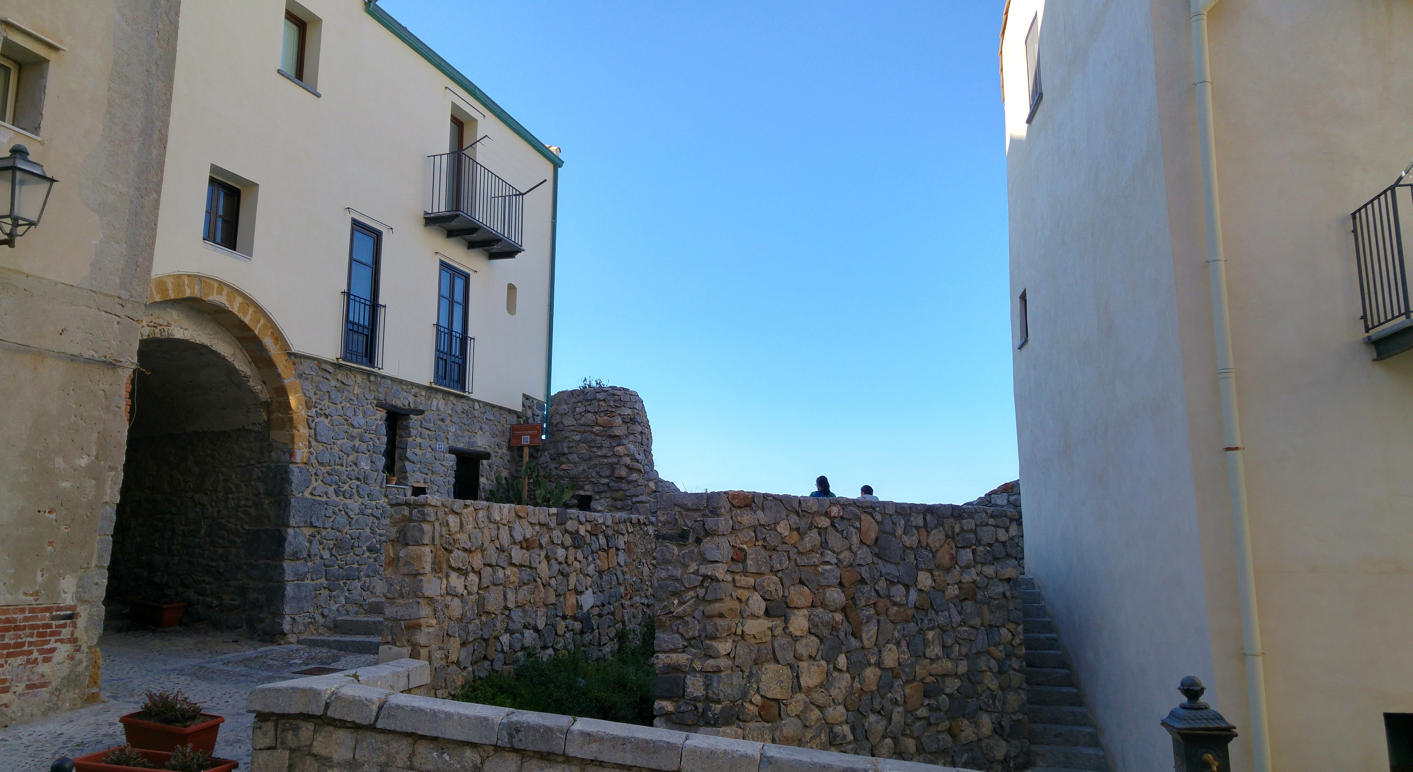
MT 5:50 PM - Cefalù: small window (lookout?) in megalithic wall next to sign in the corner of the Postierla; the steps are to the right.
The
web site QrTour at https://www.qrtour.it/cefalu22/?lang=en shows a different sign in
the same position as in Don’s photo that reads “Postierla e Mura Megalithiche –
fine V inizi IV sec. a.C.” (Postierla and Megalithic Wall – end of 5th
beginning of 4th century BC).
The Postierla (Postern) is pedestrian passage situated an inconspicuous place in the ancient megalithic defensive walls along the Guidecca cliffs. It is located to the east of Cape Marchiafava; the main entrance is in front of the Vicolo Micelli arch. It was built to allow the citizens access to fresh water that flows from a spring at sea level and accessible through a series of steps carved into the cliff. At the lower end, adjacent to the sea, there is another opening. The proximity of this place to the Cathedral and the most prominent buildings of the city suggests that it could have been an escape route created in the Middle Ages or in more recent times. It could be used to leave the city without attracting attention.
The Italian postierla translates in English as postern. The term postern comes from the Latin posterula, meaning a small back door or gate or a private entrance. In English, it came to mean a hidden, often underground, entrance or exit to a castle, hence a way of escape or refuge.
The Postierla of Cefalù faces the sea among the remains of the Megalithic Wall (5th and 4th centuries BC), and its origins are very ancient. It is flanked by monolithic jambs and is surmounted by a monolithic epistyle (a lintel or beam made of wood or stone that rests on columns), which is damaged on the outside, but perfectly preserved on the inside.
See https://panormus.es/Cefalu/Postierla.html or https://panormus.es/Cefalu/Postierla-imagenes/arco-Vicolo-Miceli-y-acceso-Postierla.jpg for a photo of the Postierla with the part of the megalithic wall on the right and the Vicolo Micelli arch at the left.
The Postierla (Postern) is pedestrian passage situated an inconspicuous place in the ancient megalithic defensive walls along the Guidecca cliffs. It is located to the east of Cape Marchiafava; the main entrance is in front of the Vicolo Micelli arch. It was built to allow the citizens access to fresh water that flows from a spring at sea level and accessible through a series of steps carved into the cliff. At the lower end, adjacent to the sea, there is another opening. The proximity of this place to the Cathedral and the most prominent buildings of the city suggests that it could have been an escape route created in the Middle Ages or in more recent times. It could be used to leave the city without attracting attention.
The Italian postierla translates in English as postern. The term postern comes from the Latin posterula, meaning a small back door or gate or a private entrance. In English, it came to mean a hidden, often underground, entrance or exit to a castle, hence a way of escape or refuge.
The Postierla of Cefalù faces the sea among the remains of the Megalithic Wall (5th and 4th centuries BC), and its origins are very ancient. It is flanked by monolithic jambs and is surmounted by a monolithic epistyle (a lintel or beam made of wood or stone that rests on columns), which is damaged on the outside, but perfectly preserved on the inside.
See https://panormus.es/Cefalu/Postierla.html or https://panormus.es/Cefalu/Postierla-imagenes/arco-Vicolo-Miceli-y-acceso-Postierla.jpg for a photo of the Postierla with the part of the megalithic wall on the right and the Vicolo Micelli arch at the left.

5:50 PM - Cefalù: looking down into the steps of the Postierla in the megalithic wall.

5:50 PM - Cefalù: looking down into the steps of the Postierla in the megalithic wall.

5:51 PM - Cefalù: sign for "Postierla" by the megalithic wall; English text reads:
"Postierla is a crossover [sic! Italian has passaggio pedonale = pedestrian passage] on the ancient defensive walls. It was built to allow the citizens access to a fresh wager spring, flowing at sea level and accessible through a stepladder [sic! Italian scaletta = stepladder or, more likely here, stairway] carved into the cliff.
"The postierla is flanked by monolithic jambs. It is surmounted by a monolithic epistyle, which is damaged on the outside, but perfectly preserved in the inside."

5:51 PM - Cefalù: view, from bottom of the steps of the Postierla, down to the opening in the megalithic wall that leads to the rocky coast of the sea.

6:16 PM - Cefalù: back on Lungomare promenade - last view of Cathedral and La Rocca (mild telephoto 49 mm).
We got back to Artemis Hotel in time to go with Lara and Chiara at 7 pm to eat pizza at Lievisa Cucina Terra Mare restaurant we had passed on the Via Giuseppe Vazzana street leading from the hotel to the Lungomare promenade.

7:52 PM - Cefalù: Artemis Hotel - painting of old-time scene on Cefalù beach, with La Rocca in right background.


.jpg)


No comments:
Post a Comment